


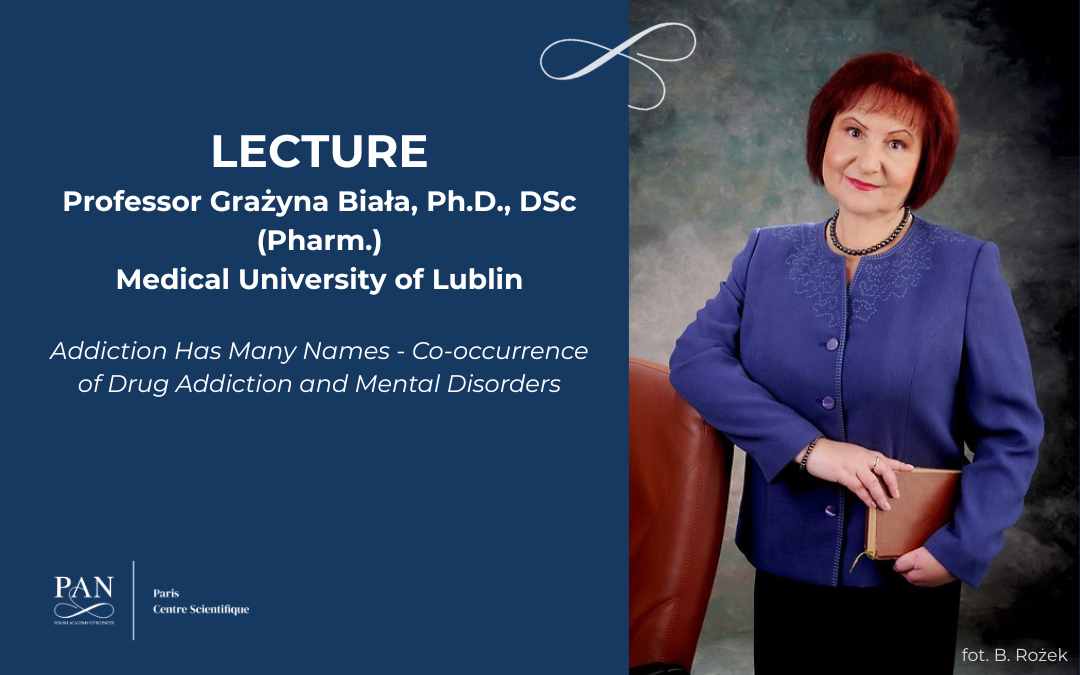
Lecture: Addiction Has Many Names – Co-occurrence of Drug Addiction and Mental Disorders
The Polish Academy of Sciences Scientific Center in Paris cordially invites you to a lecture by Professor Grażyna Biała, Ph.D., DSc, a pharmacology professor from the Medical University of Lublin. She will present her research on the co-occurrence of addiction and mental disorders. The lecture will be delivered in Polish, and its popular science form is intended for everyone interested, regardless of prior knowledge on the topic.
Event program:
6:30 PM – 7:30 PM – lecture by Prof. Grażyna Biała
7:30 PM – 8:00 PM – coffee meeting and discussion
Registration:
To register for the lecture, please send an email to secretariat@paris.pan.pl or fill out the online registration form (in Polish).
Lecture overview:
Addiction is a complex brain disease that manifests as a compulsive drive to use substances despite their harmful consequences. This is particularly true for prescription medications, whose use can come to dominate the life of the addicted individual.
The situation becomes even more complicated in the case of so-called dual diagnosis—the simultaneous presence of addiction and another mental disorder. Psychoactive substances can mimic the symptoms of neuropsychiatric diseases, and their use may serve as a form of self-medication for conditions such as depression, anxiety, psychosis, or interpersonal difficulties, or to cope with the side effects of other medications. The mechanisms underlying the co-occurrence of these disorders are often similar and point to the brain’s reward system, with elevated dopamine levels playing a key role as the main neurotransmitter responsible for pleasurable, “hedonistic” sensations. Neurodevelopmental impairments, such as those involving the hippocampus, may also underlie the development of disorders like schizophrenia, contributing to dysfunctional neural connections.
Shared neurobiological mechanisms—such as excess dopamine or hippocampal dysfunction—may be at the root of both addiction and mental illnesses. The risk of developing these conditions is influenced by factors including genetics, environment, and early childhood development.
These issues form the foundation of a research project funded by the Polish National Agency for Academic Exchange (NAWA) under the PHC Polonium program, conducted in cooperation with the Groupe de Recherche sur l’Alcool & les Pharmacodépendances (GRAP) at the Université Picardie Jules Verne (UPJV) in Amiens, France. Prof. Grażyna Biała leads the project on the Polish side, while Prof. Mickael Naassila leads it on the French side.
Speaker:
 Prof. Grażyna Biała is a Polish pharmacist and pharmacologist, professor of pharmaceutical sciences, and head of the Department of Pharmacology and Pharmacodynamics at the Medical University of Lublin.
She is the author of several hundred scientific articles and holds one patent. She is a member of numerous scientific societies, including the Committee on Physiological and Pharmacological Sciences of the Polish Academy of Sciences (PAN), and serves on the editorial boards of 25 international journals, including Neurochemical Research and Molecules.
She has received numerous awards, including three from the Polish Minister of Health, the Jędrzej Śniadecki Award of the PAN Medical Sciences Division (2019), the Gold Medal for Long-Term Service, the Honorary Badge for Merits in Health Protection, the Honorary Badge of the Polish Pharmaceutical Society, the Medal of the Medical University of Lublin, and the Commission of National Education (KEN) Medal. She has been included on Stanford University’s World’s TOP 2% Scientists list of the most-cited researchers in 2020 and 2021.
Prof. Biała has supervised 15 doctoral dissertations and led numerous externally funded research projects (including NCN Opus grants), as well as EU-funded initiatives such as High Quality Medical Education (2019–2023), and an international grant from the Visegrad Fund (2022–2023). From 1991 to 2010, she completed seven research fellowships in France (funded by INSERM and the French Ministry of Higher Education and Research), and 11 visits to European universities through the Erasmus+ program. She is also an expert for NCN, NCBiR, OPI, NAWA, PKA, and ABM.