


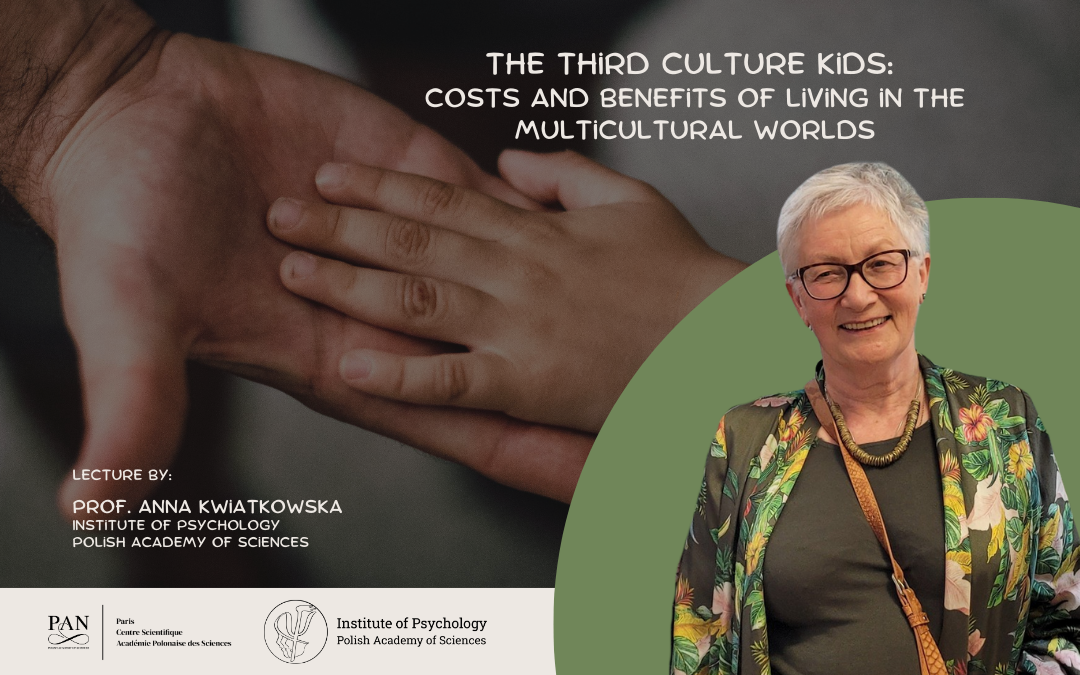
The Third Culture Kids: Costs and Benefits of Living in the Multicultural Worlds
In the 21st century, the growing number of individuals who blend multiple cultures has become a feature of global mobility. One group that represents this trend is Third Culture Kids (TCK), individuals who spend a significant part of their lives outside their parents’ home country, often due to professional relocations. The “third culture” refers to an identity that emerges from the combination of the parents’ culture and the host country’s culture.
This discussion explores the challenges and benefits of being a TCK, based on research conducted at the Cross-Cultural Lab, IP PAS, which focuses on the development of multicultural identities and the adaptation of TCKs.
Frequent relocations can impact the emotional well-being of TCKs, leading to lower self-esteem, stress, and difficulties in forming lasting relationships. A major challenge is also building a stable cultural and social identity, which may result in a sense of not belonging.
Despite these challenges, the TCK lifestyle offers several benefits, such as the development of adaptability, intercultural sensitivity, and a broader worldview. TCKs often become more tolerant, less prejudiced, and gain a global perspective. Research shows that they are more flexible, socially connected, and culturally aware than their peers.
Cultural identity is shaped not only by ethnicity or nationality. Studies indicate three main identity patterns: integration, categorization, and compartmentalization, all of which affect the well-being of TCKs.
The Polish Academy of Sciences Scientific Centre in Paris invites you to the lecture The Third Culture Kids: Costs and Benefits of Living in the Multicultural Worlds by Prof. Dr. Anna Kwiatkowska, Institute of Psychology, Polish Academy of Sciences. Her research covers social, cross-cultural, cultural, and environmental psychology, exploring topics such as acculturation, cultural identity, Third Culture Kids, and gender-related identity issues. She has authored numerous publications in international journals, including Wielokulturowość w ujęciu interdyscyplinarnym (2019) and The small and big deceptions (2015).
The event is organized as part of the “Meetings with Science” project, a series of popular science lectures organized by the Polish Academy of Sciences and the Polish Academy of Sciences Scientific Centre in Paris since 2024. The aim of the project is to promote the achievements of Polish scientists in France, and it is aimed at everyone interested, regardless of their level of knowledge on the topics discussed.
Due to the limited number of places, those interested in attending the lecture are invited to register by sending an email to secretariat@paris.pan.pl or by filling out the form:
Onsite participation form: https://forms.office.com/e/18JUGubcM5
Remote participation form: https://events.teams.microsoft.com/event/18fb7bfd-007f-4f99-9261-903009c58894@c09e1b13-b101-4ccc-9d9b-05118a718591
The lecture will be held in English.