


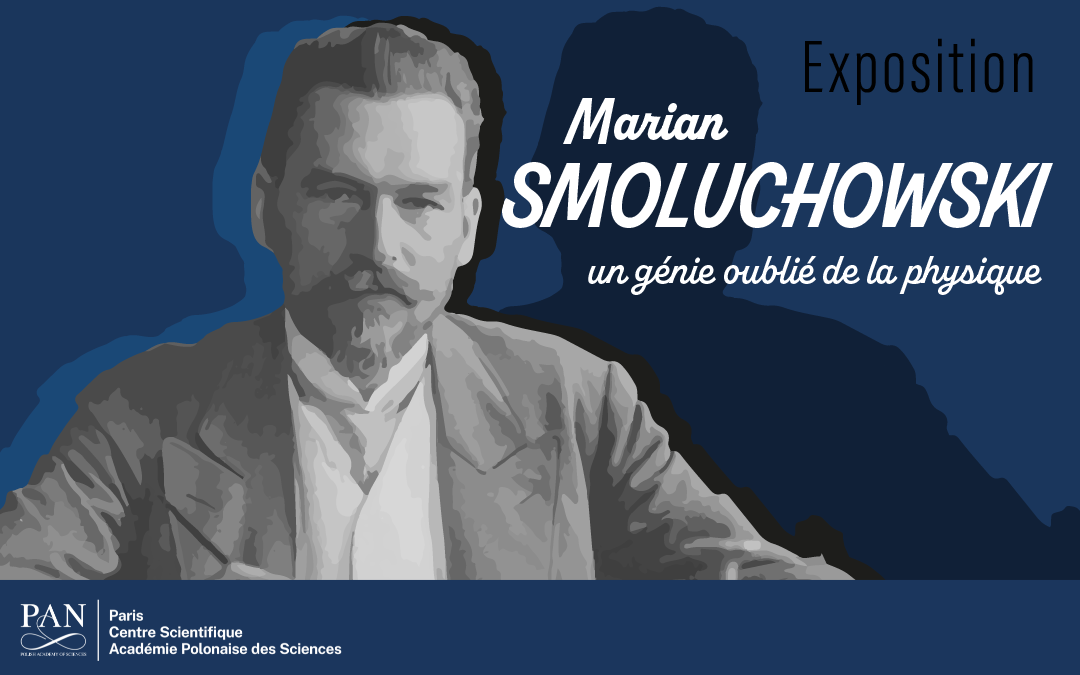
Marian Smoluchowski – forgotten genius of physics
The Polish Academy of Sciences Scientific Center in Paris is pleased to invite you to an upcoming exhibition that will showcase the life and accomplishments of Marian Smoluchowski – an exceptional Polish physicist from the turn of the 19th and 20th centuries. The exhibition started in September 2024.
Despite his groundbreaking discoveries, Marian Smoluchowski remains relatively unknown to the general public. Who was he?
Marian Smoluchowski was born on May 28, 1872, in Vorderbrühl (then Austro-Hungary) and died on September 5, 1917, in Cracow, at the age of 45. His scientific legacy includes over 100 publications in English, French, German, and Polish.
Smoluchowski was one of the most outstanding Polish physicists of the late 19th and early 20th centuries and a pioneer in modern physics. In 1904, he confirmed the possibility of observing fluctuations in physical quantities caused by the granular structure of matter. Based on this, he explained the phenomenon of Brownian motion (simultaneously with Albert Einstein), which contributed to confirming the hypothesis of the atomic structure of matter.
Smoluchowski co-developed the kinetic theory of matter, was a forerunner in applying probabilistic theory and stochastic processes to describe physical phenomena, and was a pioneer in using probability calculus in studying physical phenomena. His achievements laid the foundation for statistical physics.
According to Prof. A. K. Wróblewski, an experimental physicist, historian of physics, expert in particle and high-energy physics, and a full member of the Polish Academy of Sciences, Smoluchowski is one of four Poles who made discoveries worthy of the Nobel Prize.
The exhibition Marian Smoluchowski – forgotten genius of physics will be on display from 9 September to 10 December 2024 from 9:30 am to 1:00 pm., 2:00 pm. to 4:30 pm. at the Polish Academy of Sciences Scientific Center in Paris (74 rue Lauriston). The exhibition will be available in two languages: Polish and French.
Admission is free.